About Knock at the Door
What skills are we trying to teach?
The need for this project was identified by a Senior Police Officer when speaking at a Serious Violence Strategy Group meeting. Peer-to-peer sharing of images between children was identified as the fastest-growing area of sexual abuse, and the current policing response was described as offering an ineffective response. A Superintendent explained, “One of the biggest problems that we face is children sharing sexual images with one another, peer-to-peer sharing. This is a crime and when it is reported to us, a police officer has to knock on the door of a family. When families find out that their child has been involved in a crime, the family often experiences trauma. This is not the impact that we want to create and we need to consider alternative, preventative approaches.”
In response to this call to action, a programme of learning called “A Knock at the Door” was developed. This programme is designed to help children develop positive help-seeking behaviour; specifically, it provides children with the vocabulary required to talk to adults about the law and what it says about indecent images of children.
How do we teach these communication skills?
“A Knock at the Door” starts with a short film that shows police officers calling at a family home where children have been sharing indecent images; a crime has been committed.
Fill in the blanks
it is an [blank:offence] to [blank:make] [blank:take], [blank:possess], or [blank:distribute] indecent images of a child.
It is an offence that can also be [blank:committed] by a [blank:child].
Word bank
mistake
give
possess
make
distribute
see
talk about
committed
child
taken
offence
friend
know about
take
The learning resource then contains a series of activities to help children learn the vocabulary required to talk about the law and what it says about the sharing of indecent images of children. In the activity above, children are asked to recall the words used by police officers in the film.
After learning that vocabulary, children are asked to step into the role of a parent to explain the law to a child.
Does this approach deliver positive outcomes?
Independent evaluation conducted by Liverpool John Moores University proves that this approach delivers outcomes for young people. These include the following:
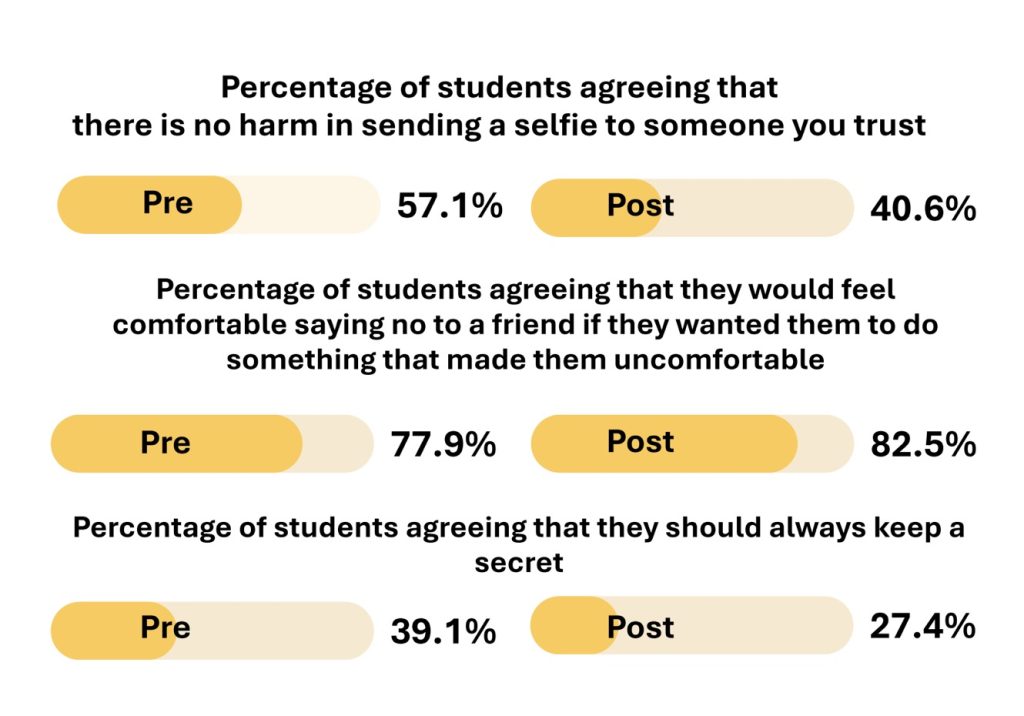
This data was taken from the Evaluation of the Ariel Trust Violence Reduction Education Programmes in Primary Schools across Merseyside: Summary report of delivery and impact between 2022-2025. This was written by Nadia Butler, Charley Wilson, Ann Marie Farrugia, and Zara Quigg of the Public Health Institute, Liverpool John Moores University, Tithebarn Street, Liverpool, L2 2QP.
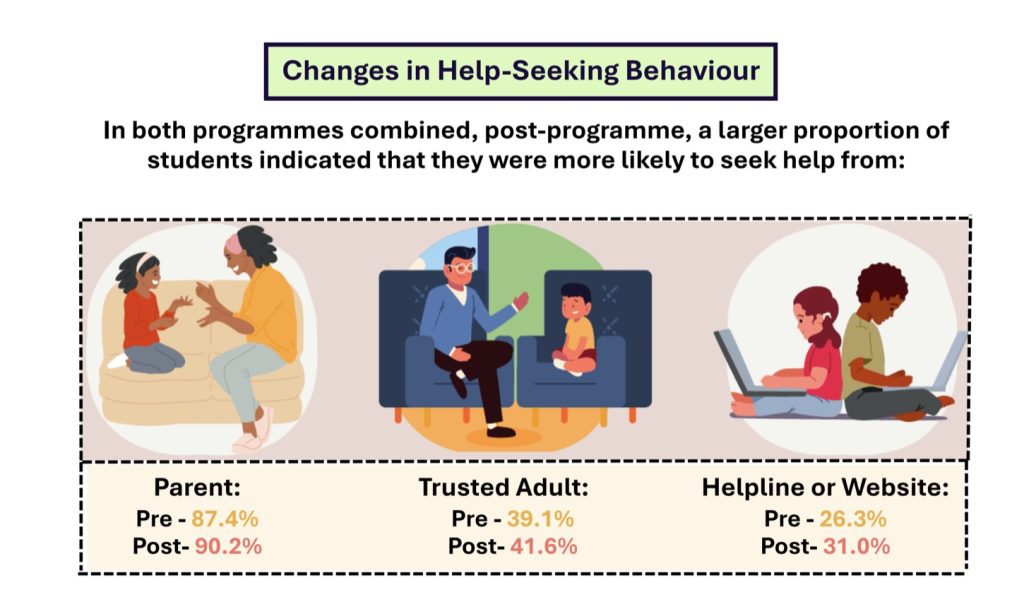
The LJMU report also found positive changes associated with help-seeking behaviour.
Can we engage parents I these difficult conversations to support children?
In order to maximise the impact of violence reduction education, Ariel Trust is currently developing resources that make it easier for schools to engage parents in drama-based workshops. These resources are freely available under the menu entitled “Parental Engagement”, and you can watch one of our parental engagement workshops taking place below:
If you would like to become a partner school and are willing to deliver parental engagement workshops, we would like to hear from you. Please contact admin@arieltrust.com.
